
MENU
Most motorcycle jeans are built to protect but few are built to last, and almost none are built with the planet in mind. Conventional denim is one of fashion’s most polluting products: a single pair can travel up to 65,000 km during production, consume hundreds of liters of water, and shed microplastics into the ocean with every wash.
ARMALITH was not designed primarily as an eco-friendly motorcycle jeans fabric. It was designed to be the strongest, most protective denim in the world. But when Pierre-Henry Servajean ran the numbers on his finished fabric’s carbon footprint, the result was striking: ARMALITH’s unique construction and cold manufacturing process deliver a carbon footprint 80% lower than conventional denim making it arguably the most sustainable motorcycle jeans fabric ever made.
Here’s how it happened and why it matters.
Sustainability in textile manufacturing comes down to three things: what the fabric is made of, how it is made, and how long it lasts. ARMALITH delivers on all three not as a marketing claim, but as a direct consequence of the engineering decisions made to achieve maximum road rash protection.
The reinforcement fiber at the heart of ARMALITH UHMWPE is not just the strongest fiber used in motorcycle jeans. It is also one of the most environmentally responsible.
Compared to Kevlar®, UHMWPE requires half the energy to produce. It bypasses the energy-intensive texturization process that most synthetic fibers require to achieve a textile appearance because ARMALITH’s cotton wrapping handles that at the thread level. Its continuous fiber structure also eliminates the cracking operation needed to mimic natural fiber lengths.
Beyond production, UHMWPE’s environmental profile extends to its behavior in use:
ARMALITH is built on a streamlined global supply chain, where each step is positioned to minimize unnecessary transport. From fiber production in Asia to spinning, weaving, and garment manufacturing, the process follows a logical, forward-moving flow toward end markets in Europe and the US reducing back-and-forth logistics while maintaining full control over quality and performance.
This supply chain gives ARMALITH full traceability at every stage from raw fiber to finished fabric and is underpinned by a commitment to working exclusively with manufacturing partners who meet ARMALITH’s strict environmental and quality standards.
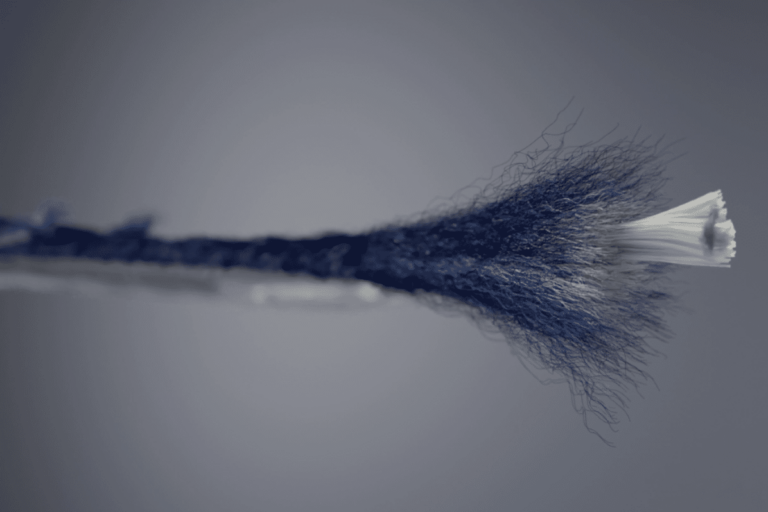
Every manufacturing process for ARMALITH is carried out cold: spinning, indigo dyeing, weaving, and finishing. This is not a choice made for marketing purposes it is a technical necessity imposed by UHMWPE itself, which turns out to be a major ecological advantage.
UHMWPE’s exceptional mechanical properties can be compromised by contact heat above 87°C. Conventional stretch fabrics are typically heat-set at 180°C a direct conflict. It took Pierre-Henry four years of testing and significant development investment to create a low-temperature heat-setting process capable of stabilizing Lycra® without damaging the UHMWPE fiber’s performance.
The ecological consequences of this cold process are significant at every stage:
Indigo dyeing is one of the most water-intensive processes in denim manufacturing. For ARMALITH, it is carried out completely dry, thanks to the exclusive Dry Indigo® technology the only process of its kind in the world.
The numbers speak for themselves:
The single most sustainable thing a motorcycle jeans fabric can do is last. Every year that an ARMALITH garment stays in service is a year that a new pair of conventional jeans does not need to be produced, shipped, and eventually discarded.
ARMALITH motorcycle jeans are delivered raw no pre-washing, no sandblasting, no chemical finishing. This reduces water consumption from 200 liters to just 3 liters per pair compared to conventionally finished denim. For riders who prefer a washed look, ARMALITH is fully compatible with laser and ozone finishing techniques the most eco-friendly washing methods available.
Raw ARMALITH denim ages beautifully and intentionally. The indigo develops a natural patina over time, fading on raised surfaces and friction points in patterns reminiscent of the ridges of Mount Fuji the same aging process prized by Japanese raw denim enthusiasts. The difference is that where Japanese raw denim typically gives out after four years of wear, ARMALITH’s UHMWPE skeleton keeps the fabric structurally intact indefinitely. The aging process never ends. The jeans essentially never wear out.
With abrasion resistance certified up to 120 km/h, available across seven technical denim ranges suited to everything from daily urban commuting to track days, ARMALITH motorcycle jeans represent a genuine lifetime investment for the rider, and for the planet.
*Required fields
Your information is processed by computer to allow ARMALITH to manage your request.
To exercise your rights in accordance with the law “IT and freedoms”, click here.