
MENU
Most motorcycle jeans fail where it matters most: on asphalt. And the gap between what CE certification promises and what actually happens in a real crash is wider than most riders realize. Standard denim tears apart in under 5 meters. CE AA-rated jeans allow skin temperature to exceed 100°C within 10 meters of sliding. Even dedicated Kevlar®-lined motorcycle jeans fall short of what a real crash demands.
ARMALITH was built to close that gap. It is currently the only single-layer motorcycle jeans fabric in the world that delivers CE AAA-level road rash protection without a lining tested not in a laboratory, but on real asphalt, under real crash conditions, witnessed by a certified bailiff and professional stunt riders.
Here’s what the data shows.
Surveys consistently show that around 70% of motorcyclists wear jeans when they ride. Not leather trousers, not textile overpants jeans. The reason is simple: comfort, style, and versatility. Riders want to arrive at their destination looking like a person, not a crash test dummy.
The problem is equally simple: no conventional jean offers meaningful road rash protection. When a rider goes down at speed, the body slides across asphalt and the fabric stretches under extreme tensile force until it tears. This is abrasion the action of wearing down by friction and it happens faster than most riders imagine.
The CE-17092 motorcycle standard sets a minimum tear resistance of 50N. A standard pair of jeans delivers nowhere near this. And even garments that meet CE AA certification have been shown to allow dangerous levels of skin heating within the first 10 meters of a slide a criterion the standard itself does not measure.
Pierre-Henry Servajean experienced this firsthand. After a crash that destroyed his jeans and left his skin exposed to asphalt, he spent years developing a fabric that would solve the problem permanently. The result was ARMALITH a patented single-layer composite fabric that delivers between 100N and 500N of tear resistance depending on the grade, compared to the 50N minimum required by CE certification.

The warp thread features a UHMWPE technical core wrapped in cotton, dipped in indigo for authentic denim aesthetics. The weft thread pairs a smaller UHMWPE core with Lycra® for stretch and comfort. Ecru cotton finishes the structure, creating a breathable, hydrophilic fabric that looks and feels like genuine raw denim.
UHMWPE the high-performance fiber running like a skeleton through every thread is what makes ARMALITH genuinely rip-proof. Originally developed for aerospace and defense applications, UHMWPE is used in solid form to armor military vehicles. As a fiber, it delivers properties no other textile material can match in motorcycle jeans:
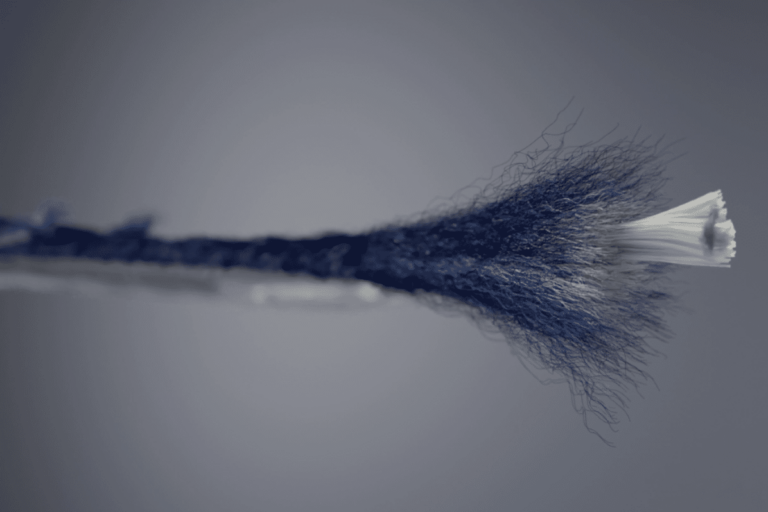
This precise composition is what gives ARMALITH motorcycle jeans their unique combination of properties: supple, soft, and breathable like real denim, with a natural indigo patina that develops over time and a structural integrity that conventional jeans simply cannot replicate.
When Pierre-Henry tested materials for his composite fabric, he evaluated carbon, Kevlar®, ceramic, and even diamond. All were theoretically compatible with ARMALITH’s architexture. Only UHMWPE checked every box and the four key performance properties it brings to ARMALITH motorcycle jeans explain exactly why:
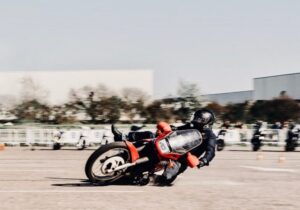
With a density of just 0.95 kg/L light enough to float on water, compared to 1.6 kg/L for other reinforcement fibers UHMWPE is what allows ARMALITH motorcycle jeans to feel like everyday denim rather than protective gear.
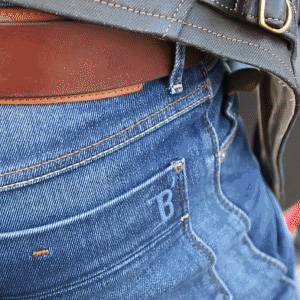
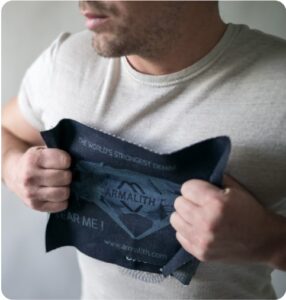
Many protective fibers lose their mechanical properties when exposed to UV rays. Kevlar® absorbs atmospheric moisture, which reacts with UV radiation to oxidize and break down its carbon chains quietly reducing protection with every sunny ride. UHMWPE has a 0% moisture regain rate, making UV oxidation impossible. ARMALITH motorcycle jeans retain their full road rash protection through years of riding, washing, and UV exposure.
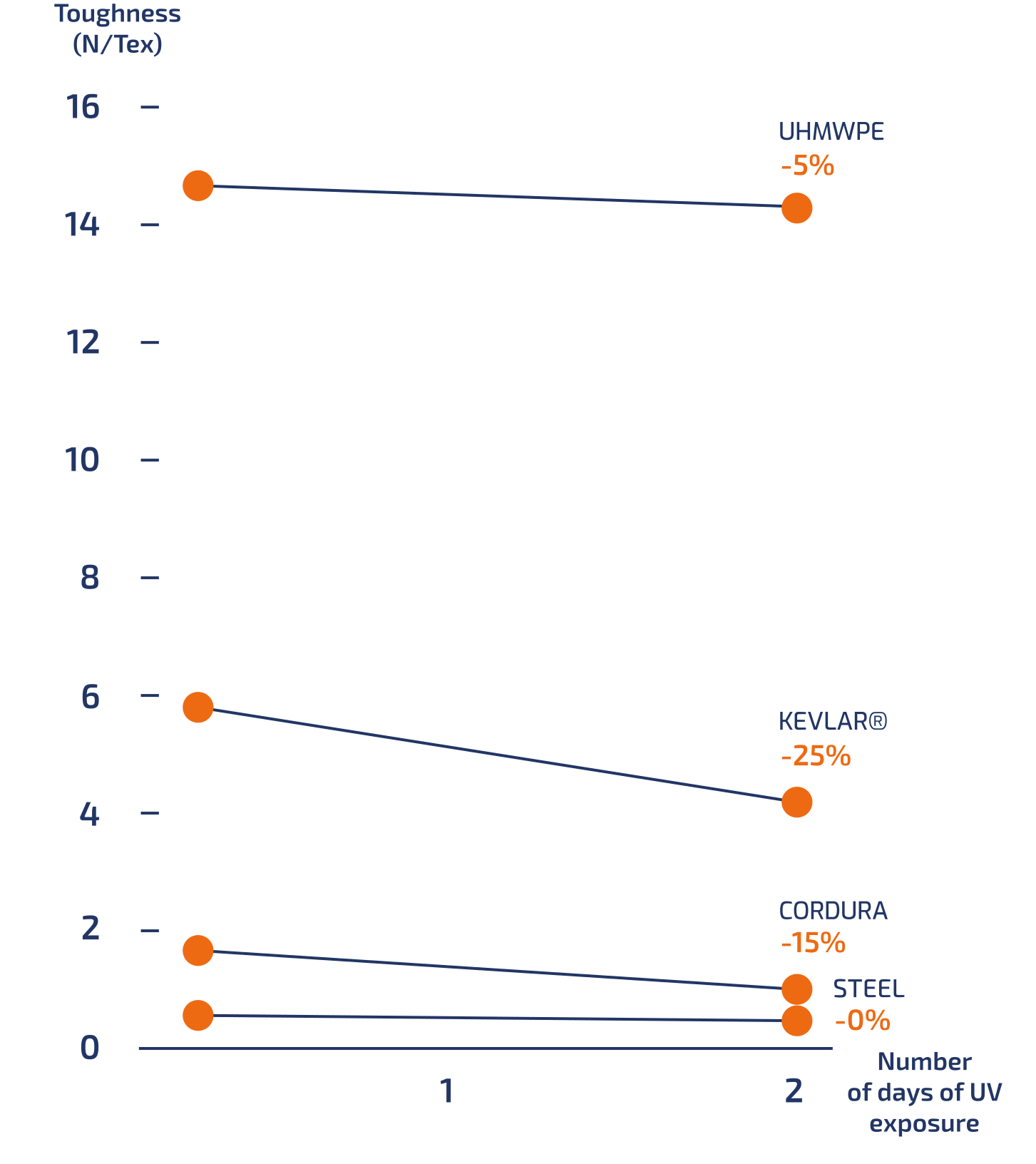
Laboratory testing tells part of the story. Real-world asphalt testing tells the rest and this is where ARMALITH’s performance becomes impossible to ignore.
The ARMALITH Test Days protocol
To validate ARMALITH’s road rash protection under genuine crash conditions, Pierre-Henry designed the ARMALITH Test Days: a rigorous comparative test protocol conducted entirely outside the laboratory, on real asphalt, with professional stunt riders and a certified bailiff overseeing every run.
Over 60 pairs of jeans were pushed to their absolute limits. The protocol was precise: constant traction speed, exact measurement of distance covered before tearing, real-world surface conditions replicating a motorcycle crash slide. Every fabric tested including all ARMALITH grades and a representative selection of market alternatives — was evaluated on the same surface, under the same conditions, at the same speeds.
CE AAA vs racing leather at 80 meters
The results were unambiguous:
Standard non-motorcycle jeans tore apart in under 5 meters
CE AA-rated motorcycle jeans allowed skin temperature to exceed 100°C within 10 meters a threshold the CE standard itself does not measure or prevent
ARMALITH AAA motorcycle jeans matched the performance of racing leather trousers over 80 meters of sliding
This is the only direct, real-world comparison between ARMALITH and racing leather conducted under controlled, independently witnessed conditions. It demonstrates not only that ARMALITH exceeds current CE standards, but that those standards developed in laboratory conditions fail to capture the full picture of what happens on real asphalt in a real crash.
ARMALITH, in a single layer of fabric, exceeds the Darmstadt abrasion standard and the Cambridge abrasion distance standard the two benchmarks used to certify motorcycle protective textiles. It does so while looking, feeling, and aging like authentic raw denim developing the same natural indigo patina prized by denim enthusiasts worldwide.
For the 70% of riders who choose jeans because they refuse to compromise on comfort and style, ARMALITH motorcycle jeans represent the only honest answer to road rash protection: a garment that is genuinely protective, genuinely comfortable, and genuinely worth wearing every time you ride.
One layer. No lining. No road rash.
*Required fields
Your information is processed by computer to allow ARMALITH to manage your request.
To exercise your rights in accordance with the law “IT and freedoms”, click here.