
MENU
ARMALITH stretch denim is a patented composite fabric, developed in 2003 by Pierre-Henry Servajean. It is built around aerospace-grade UHMWPE fibers wrapped in cotton integrated directly into the fabric structure. Its primary objective: offer a credible alternative to leather protection, while remaining as comfortable as everyday jeans.
Achieving that level of comfort required genuine stretch performance. The solution lay in combining specific fibers within a precise yarn architecture one that moves with the body while maintaining structural resistance. This article explains how ARMALITH delivers both abrasion protection and denim-like flexibility in a single layer.
No textile fiber combining flexibility and structural resistance existed when Pierre-Henry began his research. His approach was to pair well-known textile fibers with high-performance non-textile materials. He tested carbon, Kevlar®, ceramic, and polyethylene as potential reinforcement candidates.
UHMWPE Ultra High Molecular Weight Polyethylene was ultimately selected. It offers the highest impact resistance of all thermoplastic compounds. Furthermore, it has a low friction coefficient, does not absorb moisture, and is self-lubricating. Prior to ARMALITH, UHMWPE was used in ropes, composite panels, paragliding equipment, and military applications. However, it had never before been applied in clothing textiles.
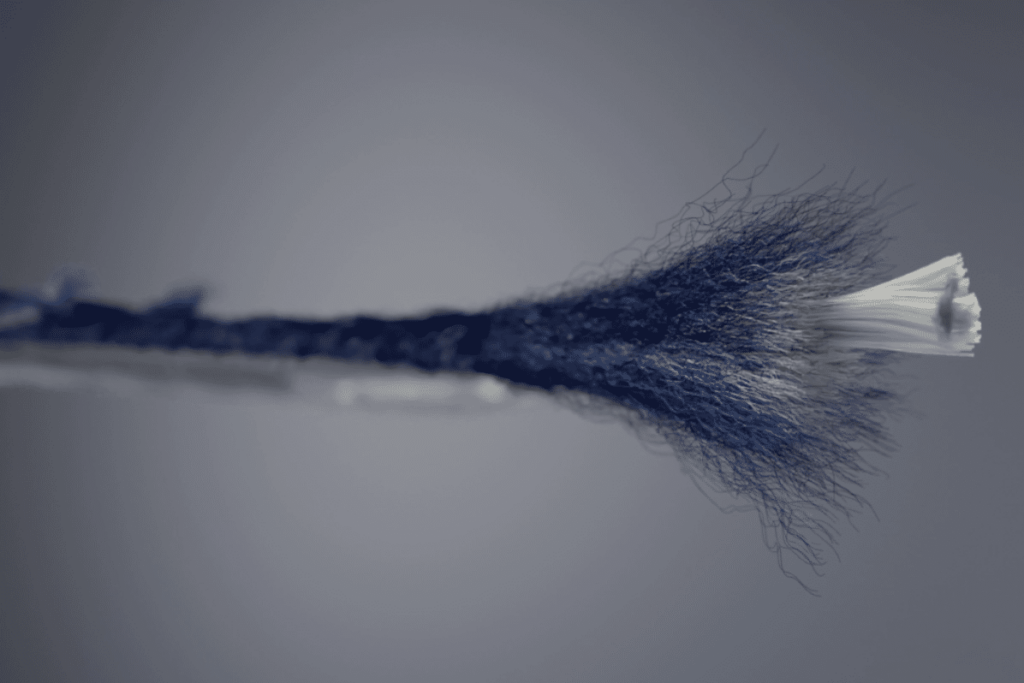
Together, these three materials produce a composite fabric that is supple, soft, breathable, and indigo-dyed. An industrial material is therefore repurposed into a technical textile accessible to any garment manufacturer seeking protective denim without a lining.
The stretch performance of ARMALITH stretch denim is not only the result of its materials. It also depends on how those materials are constructed together.
ARMALITH uses a specific yarn architecture the architexture. The warp thread features a UHMWPE technical core, wrapped in cotton and dipped in an indigo bath. This gives the fabric its authentic denim appearance. The weft thread uses a smaller UHMWPE technical core, sized to accommodate Lycra® for stretch and next-to-skin flexibility. The entire structure is then finished with ecru cotton, producing a hydrophilic, breathable surface.
As a result, UHMWPE provides structural resistance throughout the fabric. Lycra®, positioned in the weft, enables the stretch properties expected of everyday motorcycle jeans. There is no inner lining, no added layer, and no tradeoff between protection and wearability.
Each material in ARMALITH has a defined function. Lycra® also known as elastane is responsible for the fabric’s stretch performance.
Developed by DuPont in the 1950s, Lycra® is well established in sportswear, swimwear, and performance apparel. It is defined by three key properties: elongation of up to 600% before rupture, full shape recovery after each stretch cycle, and faster drying than conventional fabrics. In addition, it has largely replaced latex and rubber in performance textile applications outperforming jersey, fleece, and Milano across most comfort metrics.
In ARMALITH, Lycra® is used as a bi-component in the weft thread alongside T400 a stretch polyester. This combination further optimizes flexibility and recovery. Its placement within the weft construction ensures it functions without compromising the UHMWPE reinforcement in the warp.
The Lycra® in ARMALITH stretch denim is cold heat-set during manufacturing. This process minimizes energy consumption while preserving the fiber’s elasticity. The result is a protective denim that retains its stretch performance for up to 1,000 wash cycles a durability profile that conventional stretch fabrics cannot offer.
*Required fields
Your information is processed by computer to allow ARMALITH to manage your request.
To exercise your rights in accordance with the law “IT and freedoms”, click here.