
MENU
It sounds like a bold claim and yet it’s the simple truth: there is indeed, in the world of textiles, a tear-proof fabric that withstands every challenge. ARMALITH makes it possible to create the world’s most resistant jeans, capable of standing up to abrasion, sunlight, moisture, and everyday wear.
A tear-proof fabric doesn’t just appear on the textile market by chance. ARMALITH exists because of a stark reality: 70% of motorcyclists wear jeans when riding meaning 70% of riders choose to prioritize comfort and style, knowing full well that no comfortable garment will ever protect them from sliding across tarmac after a crash.
It was this statistic and a motorcycle accident that led Pierre-Henry Servajean to develop a tear-proof fabric capable of withstanding the most decisive factor in motorcycling: abrasion.
Tearing is a phenomenon that occurs naturally when fabric comes into contact with asphalt: the body slides, the fabric stretches until it gives way. This tearing is the direct result of abrasion the action of wearing down by friction, to use the strict definition.
The CE-17092 motorcycle standard requires a minimum tear resistance of 50N, while the ARMALITH fabric range delivers between 100N and 500N.
ARMALITH’s abrasion resistance makes it a literally tear-proof fabric, tested repeatedly in extreme conditions. In doing so, ARMALITH exceeds current standards and challenges test protocols that take place far from real asphalt in a laboratory.
When Pierre-Henry developed ARMALITH, his goal was to create a fiber as comfortable as a classic pair of jeans, yet as strong and resistant as steel or even more so. The problem was that no such high-quality textile fiber existed.
Pierre-Henry then had the idea of combining different worlds to create a composite fiber: pairing a fabric with a material renowned for its strength, such as carbon or ceramic. This technical material is integrated in a unique way, creating a distinctive textile architecture also known as an “architexture.”
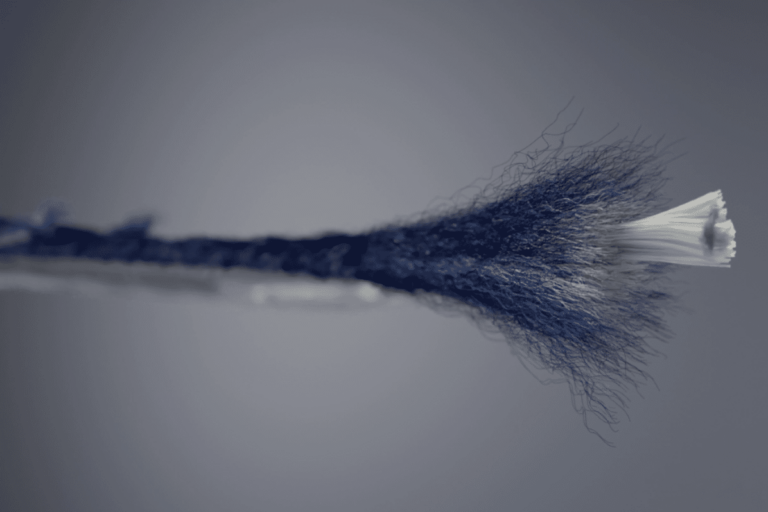
The warp thread features a technical core wrapped in cotton, then dipped in indigo baths to achieve the authentic denim look, while the weft thread (visible on the inside of the fabric) features a smaller technical core to make room for Lycra® and its comfort properties. Everything is then covered in ecru cotton to preserve the hydrophilic appearance and function that have made denim’s reputation.
It is this specific structure, combined with the chosen materials, that allows ARMALITH to be a single-layer fabric that is ultra-resistant, tear-proof, tenacious, lightweight, and impervious to sunlight.
The precise composition of ARMALITH breaks down as follows:
Cotton and Lycra® are well-known fibers in the textile world. What makes ARMALITH more intriguing is, of course, the six-letter acronym UHMWPE and yet it is precisely within those six letters that the secret to ARMALITH’s resistance lies.
When Pierre-Henry conceived his composite fabric, he tested a wide range of materials: once the architecture was in place, it could theoretically accommodate carbon, diamond, or Kevlar®. None of these were selected simply because only UHMWPE ticks every single box.
UHMWPE belongs to the polyethylene family in full, Ultra High Molecular Weight Polyethylene, also known as “high-density polyethylene.”
This material most commonly known in solid form for armoring military vehicles is renowned for its very high impact resistance, its unique ability to repel moisture, and above all its extreme abrasion resistance.
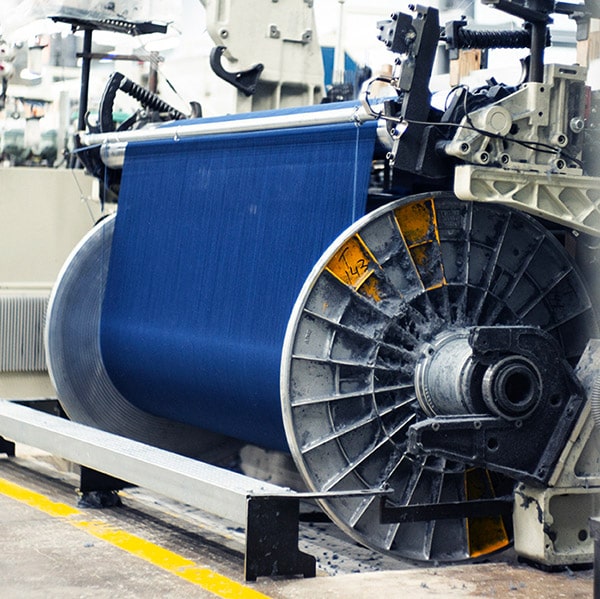
Thanks to UHMWPE, ARMALITH delivers 4 key performance properties:
Produced in Spain by Royotec, ARMALITH has thoroughly proven itself and continues to undergo rigorous quality control.
To test ARMALITH’s resistance to tearing and abrasion, the fabric had to be genuinely put through its paces. During the ARMALITH Test Days, Pierre-Henry designed meticulous tests that involved pushing over 60 pairs of jeans to their absolute limits.
The protocol was precise: a constant traction speed and an exact measurement of the distance covered before tearing. Everything was carried out outside the lab, in real-world conditions, under the expert eye of a bailiff and professional stunt riders.
This scientific comparison between a range of fabrics representative of the market including all ARMALITH® grades was conducted as close as possible to the real conditions of a motorcycle crash. Among other findings, it demonstrates that CE certification does not provide an absolute measure of abrasion resistance.
For example, CE AA-rated garments do not protect the rider against abrasion: after just 10 meters of sliding, skin temperature exceeds 100°C a criterion that the standard does not measure.
Another key finding: an ARMALITH AAA jean matches the performance of a racing leather trouser over a distance of 80 meters. As for standard non-motorcycle jeans, they simply tear apart in under 5 meters.
The verdict: ARMALITH, in a single layer of fabric, exceeds the established standards in the motorcycle world (Darmstadt for abrasion, Cambridge for abrasion distance). Thanks to this single-layer textile technology, the fabric delivers the authentic look of denim while shattering every benchmark for tear and abrasion resistance. ARMALITH can unquestionably become THE textile synonymous with freedom the one that lets you wear something that is aesthetic, protective, and comfortable, all at once.
*Required fields
Your information is processed by computer to allow ARMALITH to manage your request.
To exercise your rights in accordance with the law “IT and freedoms”, click here.