
MENU
The Gore-Tex membrane or simply Gore-Tex is a technology and an invention that transformed the way waterproof garments are conceived and manufactured. Since the 1950s, the company founded by Bill Gore has continuously expanded its product range, now covering a wide range of products primarily designed for outdoor use.
What is the secret behind Gore-Tex? How did this technology change the textile industry? And how did the brand manage to explain its technology and make it accessible to a general audience?

Gore-Tex was born in the late 1950s in Newark, Delaware, USA. Bill Gore was working at DuPont a company that had pioneered the plastics revolution and was responsible for discovering nylon and polymer materials such as Teflon, Kevlar, and neoprene. Bill Gore observed that Teflon was being significantly underestimated by his employer. He saw an opportunity to use this material to manufacture garments. However, DuPont was reluctant and refused to develop the idea. Bill Gore chose to leave.
He launched his own company with the objective of exploring the full potential of Teflon. Together with his wife Genevieve, he began his research from the basement of their family home. Although Bill was convinced that Teflon held untapped possibilities, the early years were difficult. It was not until the late 1960s that Bill and his son achieved their first meaningful results.
Their experiments led to the creation of a material that allowed perspiration to escape while blocking water droplets from entering. Gore-Tex was born. Bob Bill’s son achieved this by stretching and modifying Teflon to create expanded polytetrafluoroethylene (ePTFE): a microporous material capable of blocking incoming water droplets while allowing outgoing water vapor to pass through, due to the size of its micropores.
This discovery led to Gore-Tex’s first patent. Many more followed, as the family continued to develop new technologies from the PTFE polymer. Once the patent was filed, Gore-Tex moved into garment design. The first models reached the market in 1976 the first waterproof and breathable windbreakers ever produced.
Gore-Tex is the result of two innovations: the use of expanded Teflon, and the development of a specific textile architecture built around a membrane.
To understand how Gore-Tex works, it helps to first understand what a membrane is. It is an extremely thin and fragile layer, positioned between two resistant fabrics. This membrane contains approximately nine billion pores each one 20,000 times smaller than a water droplet. Water therefore cannot penetrate, whether in the form of rain or snow.
The equation does not stop there. How can water droplets be blocked while allowing perspiration to escape? By creating a membrane that prevents rain and snow from passing through, while allowing water vapor to exit. The Gore-Tex membrane contains pores that are 700 times larger than a water vapor molecule. This produces a breathable fabric.
Once the membrane was developed, it needed to be paired with other, less fragile materials. The Gore-Tex membrane is therefore concealed between a textile lining and several high-performance outer fabrics. The result of this membrane and its specific architecture: waterproofing, breathability, comfort, and durability.
It is breathability that makes Gore-Tex particularly innovative. In the 1960s, waterproof garments existed but none allowed perspiration to escape. Gore-Tex garments stand out for their comfort: if you go hiking or play sport in the rain, you will experience no sensation of dampness or stuffiness.
The other innovation lies in the fabric architecture itself. The microporous membrane is structurally integrated into the fabric it is not simply added as a surface treatment. This construction makes Gore-Tex more durable and prevents degradation over time.
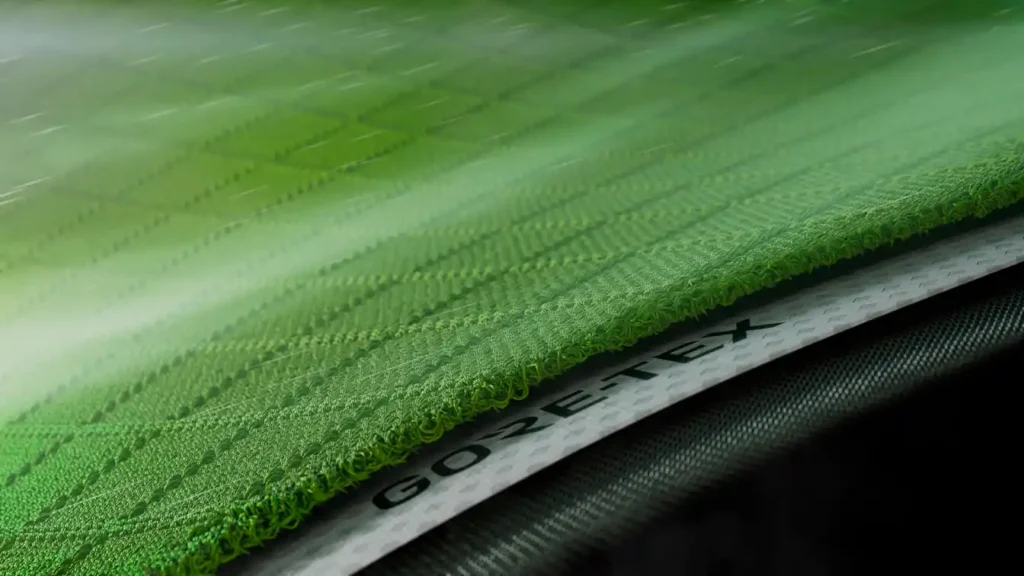
PTFE is the key material in the Gore-Tex technology. However, perfluorinated chemistry has come under significant scrutiny in 2024.
PTFE is also used as a non-stick coating for cookware the Teflon that built Tefal’s success and that is now at the center of major controversy. Materials like PTFE belong to a class of persistent chemical substances that are harmful to the planet and to human health. In English, these are referred to as “forever chemicals” substances that degrade extremely slowly.
Because Gore-Tex primarily develops garments for outdoor use and therefore for people who care about nature responding to these findings was both logical and necessary. After years of research, and some setbacks, the company developed a new material that performs well while being less harmful. Gore-Tex eventually revealed a new membrane: ePE expanded polyethylene manufactured without PFCs, while remaining waterproof and breathable.
It is likely that the company will continue improving this technology. However, current performance remains below that of the original PTFE membrane, notably due to polyethylene’s lower melting point compared to PTFE.
The first garment produced by Gore was a simple windbreaker. The company rapidly expanded its product range. Rain jackets and waterproof coats remain central to the Gore-Tex universe available in urban and adventure versions. The brand also produces trousers, widely used by hikers and outdoor professionals, as well as hiking boots, trainers, and backpacks all designed for both urban and adventure use.
For a long time, Gore-Tex was the only company to stand out in terms of waterproofing and breathability. Major competitors have since begun to close the gap notably DryVent from The North Face, and the high-performance range developed by eVent.
Gore-Tex’s longevity is also due to its capacity for continuous improvement. Shortly after the original invention, the company launched its seam-sealing tape significantly enhancing the waterproofing performance of finished garments.
Gore-Tex has also built consumer trust through clear, accessible communication. In 1989, the brand created its “Gore-Tex Guaranteed to Keep You Dry” promise allowing users to understand at a glance what a Gore-Tex garment offers, without needing to understand the underlying science. Today, consumers know exactly why a Gore-Tex rain jacket costs more than a standard windbreaker treated with a surface coating.

Gore-Tex’s history is older than ARMALITH’s. Nevertheless, it reflects a development logic that will be recognizable to anyone familiar with the ARMALITH story.
Gore-Tex started from a single material insight: Teflon a polymer had far more potential in textiles than DuPont recognized. Teflon is a polymer. Applying it to fabric construction was not an obvious step yet it gave rise to a wide range of garments. The logic is similar with ARMALITH. Pierre-Henry Servajean knew the principle of his architexture. What he needed was a sufficiently resistant material to create garments engineered to withstand asphalt abrasion. For ARMALITH, the answer was UHMWPE Ultra High Molecular Weight Polyethylene.
Creating high-performance fabrics requires more than combining resistant fibers. It requires integrating an uncommon ingredient: a polymer, a polyethylene, or a polytetrafluoroethylene. The science behind polymers is not straightforward to explain in detail. What made Gore-Tex successful was precisely its ability to build consumer confidence without requiring a complex scientific explanation becoming a trusted reference through a single ingredient and a simple label bearing the Gore-Tex name.
Once the key ingredient is identified, it must be transformed into a textile structure capable of becoming a wearable garment. This is where architecture becomes decisive.
For ARMALITH, this is called the architexture. Gore-Tex refers to a membrane and a laminate. At Gore-Tex, the robust assembly formed by the membrane and the surrounding fabrics constitutes the laminate. On the ARMALITH side, the warp thread features a technical core wrapped in cotton and dipped in indigo. The weft thread itself composed of a technical core, all covered with unbleached cotton. The result is a single-layer fabric that is highly resistant and comfortable.
What ARMALITH and Gore-Tex also share is a history of demanding testing and exceptional applications. ARMALITH is derived from aerospace fiber research. Gore-Tex, too, has connections to space: in 1981, Gore-Tex materials were used in the spacesuits of the Columbia shuttle crew.
Both technologies require research, iteration, and extensive testing. Like Gore-Tex, ARMALITH maintains strict performance control through real-world testing including the ARMALITH Test Days, conducted on real asphalt at the Jean-Pierre Beltoise circuit in Trappes.
Both Gore-Tex and ARMALITH are ingredient brands: technologies integrated into garments by third-party manufacturers, with their presence communicated through a label. For Gore-Tex, this model has operated for nearly five decades. For ARMALITH, the story is only just beginning.
*Required fields
Your information is processed by computer to allow ARMALITH to manage your request.
To exercise your rights in accordance with the law “IT and freedoms”, click here.